Solid Wood vs Veneer Furniture: A 5-Year Cost Reality Check for Singapore Homes
I still remember the day my colleague moved into her new 4-room BTO in Tampines North. She had spent S$1,800 on a glossy "solid wood" dining table from a Jurong East furniture mall. Fourteen months later, the top layer had bubbled along the edge nearest the window, and a pale paper-thin sheet was peeling back like a poorly applied HDB sticker. The substrate underneath was a sandy-coloured particle board. The store had closed, the warranty was a phone number that rang empty, and she was staring at a dining table that looked ten years older than her flat. That single evening in her corridor — measuring roughly 1.2 m wide, just wide enough for the table to be tilted in on its side — is what pushed me to actually sit down and write out the numbers behind veneer versus solid wood over a five-year window in Singapore.
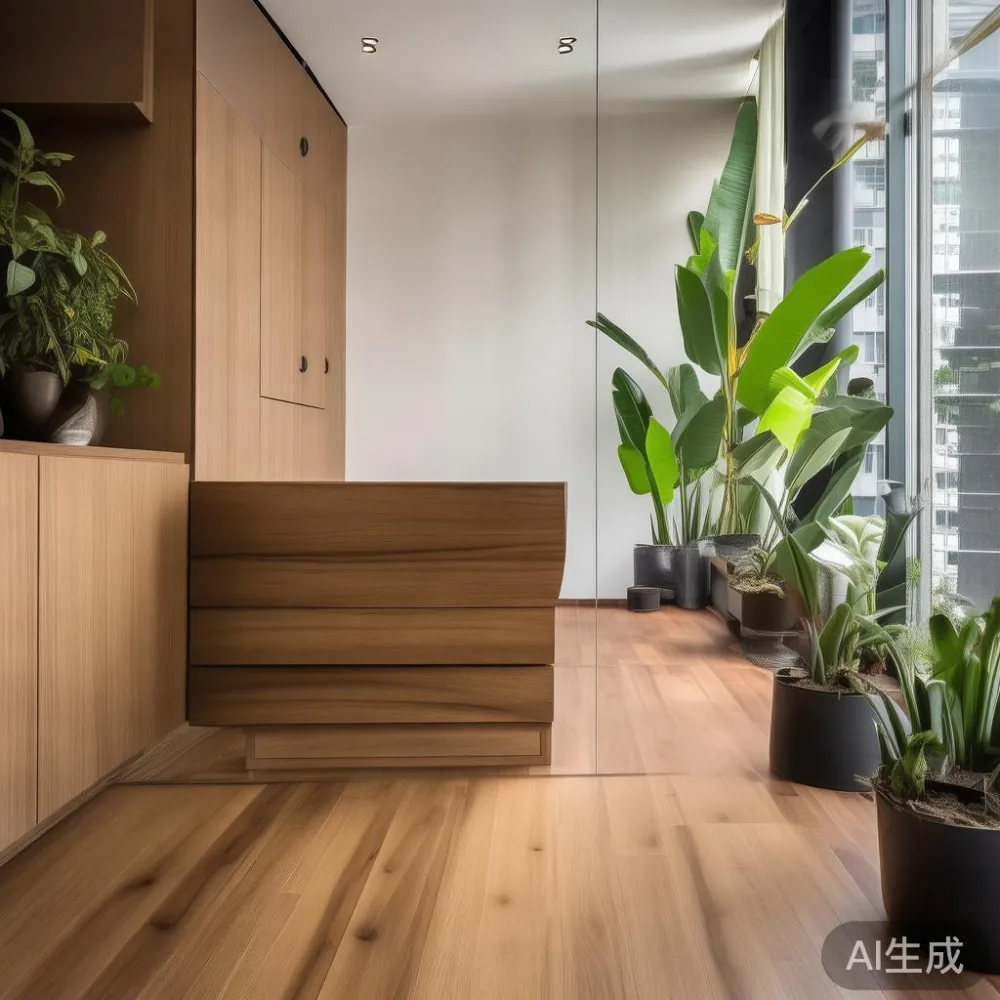
This article is for anyone shopping for a solid wood sofa, a bed frame, a dining table, a wardrobe, or a nightstand in Singapore, and who keeps seeing the same two words at almost every price point: veneer and solid wood. I will use Singapore dollars throughout, include HDB and condo realities like lift sizes (typically 1.0–1.2 m deep, 1.4–1.8 m wide) and corridor widths, account for the 9% GST, and walk through what each furniture type really costs you at year one and year five. I have also woven in a real visit to a Tampines showroom last month, where I measured, weighed, and asked very specific questions.
What is the real difference between veneer and solid wood furniture?
Solid wood furniture is cut from a single piece of timber — typically rubberwood, ash, oak, or walnut for the Singapore price band. The grain runs through the entire thickness of the board. Veneer furniture is a thin slice of real wood (often 0.5–0.8 mm) glued onto a substrate, which is usually MDF, plywood, or particle board. A 25 mm tabletop in solid rubberwood contains 25 mm of wood all the way through; a 25 mm veneer tabletop contains maybe 0.6 mm of wood and 24.4 mm of compressed glue and fibre.
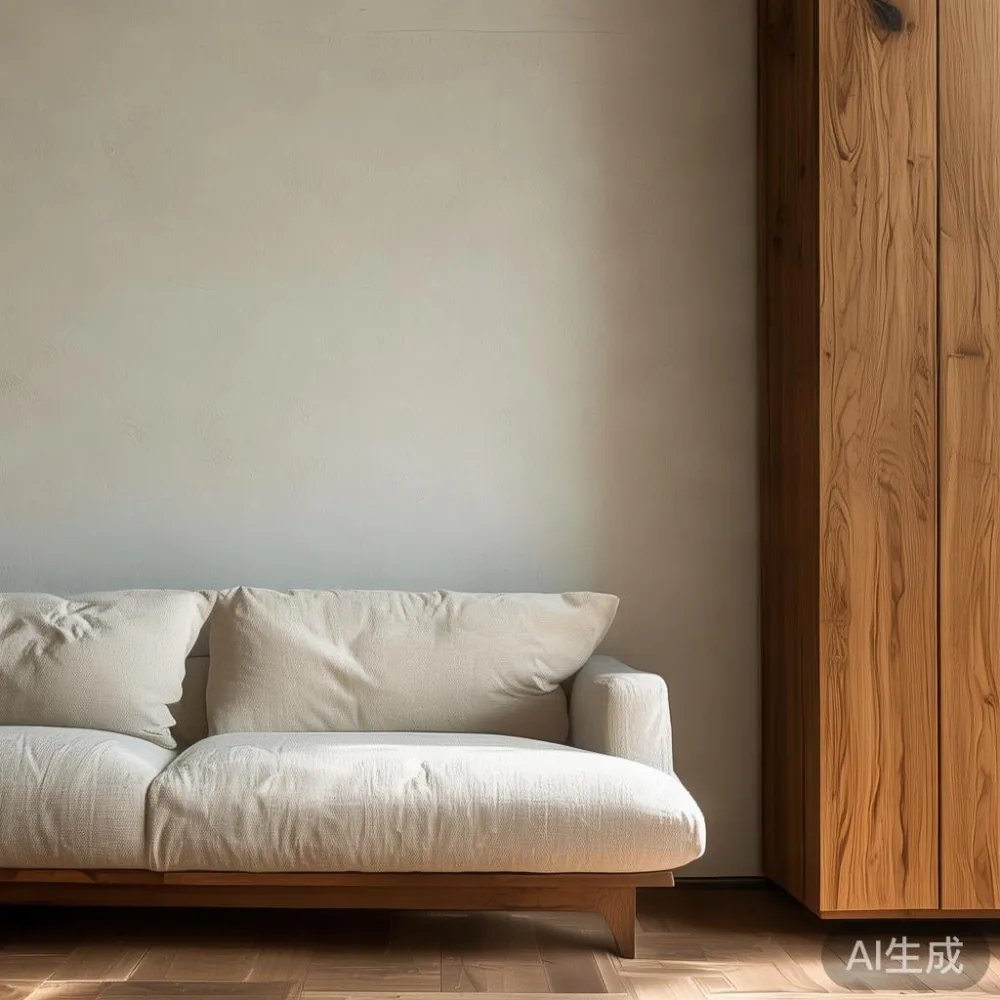
The difference sounds academic until you live with it. Solid wood can be sanded, re-stained, and refinished. A scratch on a veneer piece often cannot be repaired because sanding through 0.6 mm exposes the substrate, which will not take the same stain as the surface layer. That single technical fact is what drives almost every cost difference over a five-year period.
How much does a typical bedroom set actually cost in Singapore?
For a fair five-year comparison, I priced the same five-piece bedroom bundle — a queen bed frame, a 6-door wardrobe, two nightstands, and a dressing table with a marble tabletop — from three supplier types accessible to most Singapore shoppers. All prices below include 9% GST and delivery within mainland Singapore.
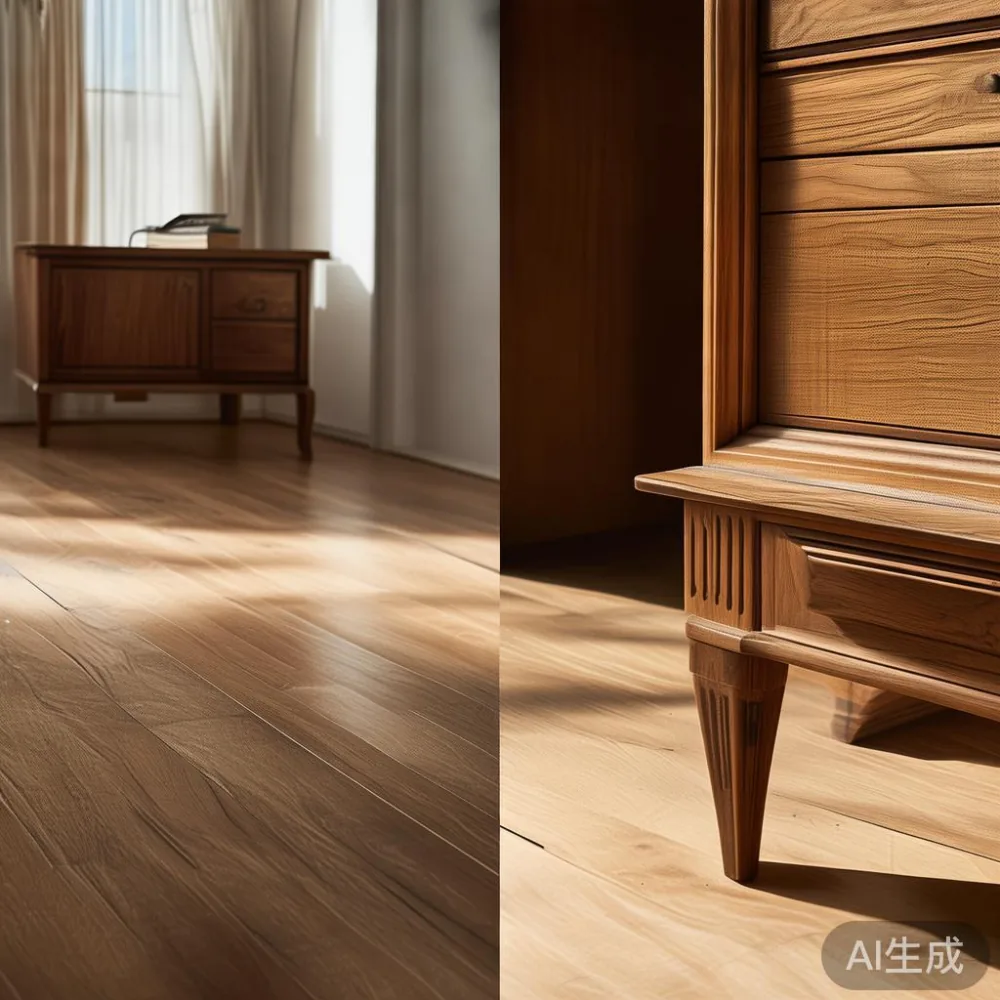
Budget veneer bundle (particle board + paper laminate, Jurong East or online): queen bed frame S$450, 6-door wardrobe S$980, two nightstands S$160 each (S$320 total), dressing table with faux marble top S$420. Bundle total: S$2,170.
Mid-range veneer bundle (MDF core + real wood veneer, common in mall brands): queen bed frame S$1,150, 6-door wardrobe S$2,400, two nightstands S$380 each (S$760 total), dressing table with real marble inlay S$1,050. Bundle total: S$5,360.
Solid wood bundle from a Foshan manufacturer shipping to Singapore (this is the category my colleague's replacement came from, and the category I will keep referring to): queen bed frame in American ash S$2,180, 6-door wardrobe in ash with solid panels S$3,950, two nightstands at S$520 each (S$1,040 total), dressing table with Carrara marble tabletop S$1,880. Bundle total: S$9,050.
The sticker shock at year one is real. Solid wood costs roughly 4.2× the budget bundle and 1.7× the mid-range veneer bundle. But sticker price is the worst measure of furniture value, because furniture is something you live with for five, ten, sometimes twenty years.
What goes wrong with veneer furniture in a Singapore HDB flat?
Singapore has three enemies of veneer furniture: humidity, sunlight, and the way we move. HDB flats in Bedok, Tampines, and Punggol regularly see relative humidity of 75–85% for parts of the year. Air-conditioning helps, but the moment you open a window or step out onto the corridor, the air is wet. Particle board substrate absorbs that moisture at the cut edges — the sides you cannot see, the back of the wardrobe, the bottom of the bed frame — and swells. Once it swells, the 0.6 mm veneer on top cannot stretch, so it cracks, bubbles, or peels. This is the colour mismatch problem I have seen in three of my friends' homes: the surface where the veneer has lifted shows a different colour than the rest of the piece, usually a dull grey-brown where the MDF core is showing through, or a paler tone where sunlight has faded only the exposed veneer and not the protected edges.
Sunlight is the second enemy. Many Singapore homes place the bed frame under a window with east or west exposure. UV light fades real wood veneer quickly and unevenly, so the part of the wardrobe hidden by the door stays the original teak tone while the exposed side turns yellow-grey within 18 months. This uneven fading is itself a form of colour mismatch, and it cannot be reversed without sanding — which, as I mentioned, removes the veneer entirely.
Moving is the third enemy. HDB residents move roughly every 7–10 years, and every move requires the bed frame, wardrobe, and dining table to fit through a corridor that is often only 1.1 m wide, a lift opening of about 0.9 m, and a service lift at the back of the block that may not be available on weekends. Particle board and MDF do not survive disassembly. A flat-pack wardrobe from a budget brand that cost S$980 new has a resale value of around S$50 on Carousell after one move, because the cam locks strip the particle board and the panels warp. Solid wood wardrobes, by contrast, can be partially disassembled and re-assembled, and retain 40–55% of their value over the same period.
Is French provincial headboard furniture worth it?
Yes — if the headboard is genuinely solid wood and not a fibreboard panel wrapped in a printed French provincial pattern, because French provincial headboard furniture is worth the premium when the carving, the curves, and the structural frame are all cut from real timber and will still look correct in ten years.
French provincial headboards are typically built around a solid beech or ash frame with routed detailing. The aesthetic depends on continuous grain around the crown curve, which is impossible to achieve convincingly with veneer. A real French provincial headboard from a maker like MIDHILL uses single boards of ash routed on a CNC, then hand-finished, which is why a 1.8 m queen headboard in this style costs S$1,250–S$1,650 rather than the S$550 you will see at mall-brand outlets. The mid-range mall version uses an MDF panel with a routed face and a printed woodgrain vinyl, which looks acceptable on day one and starts to show a clear colour mismatch along the routed grooves within 24–36 months as dust and cleaning cloths wear the printed layer off the high points while the recessed grooves stay dark.
How do refinishing costs change the five-year math?
This is where solid wood pulls ahead decisively. Most Singapore owners will lightly damage a piece of furniture at least once over five years: a hot pot leaves a ring on the dining table, a搬家 (moving day) scratch appears on the wardrobe, a child draws on the nightstand with a marker. The repair path is completely different for the two materials.
Veneer repair path: A bubbling veneer blister smaller than a 50-cent coin can sometimes be re-glued by a carpenter at S$60–S$120 per spot, but colour matching is unreliable because the surrounding veneer has faded. A peeling wardrobe door usually means full panel replacement at S$280–S$450 per door, and the new panel will be a noticeably different shade — that is colour mismatch number two, baked into the repair. Over five years, expect S$400–S$900 in veneer repair work, plus the cost of one item (usually the dressing table or nightstand) being replaced outright at S$420–S$1,050.
Solid wood repair path: A solid wood dining table can be sanded back (0.5–1 mm removed), re-stained, and re-sealed with hardwax oil in a single afternoon by a mobile refinisher, costing S$220–S$380 for a six-seater table. A scratched wardrobe panel can be spot-sanded and blended. A water-ringed marble tabletop can be re-polished. Many Foshan-direct makers — and this is where the MIDHILL lifetime refinishing model matters — offer refinishing as part of the original purchase, so the only cost is the shipping of the piece back to the workshop, which within Singapore typically runs S$80–S$160 per trip. Over five years, expect S$250–S$450 in solid wood refinishing, with every piece still functional at year five and still holding 50–70% of its original value.
What does the five-year total really look like in Singapore dollars?
Pulling the year-one purchase, mid-life repairs, and end-of-five-year resale together for the same five-piece bedroom bundle:
Budget veneer bundle, 5-year total:
Purchase S$2,170 + repairs S$600 + one replacement nightstand S$180 + resale value −S$40 (you actually pay someone to take it away) = S$2,990 net cost, or about S$50 per month. Two of the five pieces are typically unusable by year four.
Mid-range veneer bundle, 5-year total:
Purchase S$5,360 + repairs S$750 + dressing table replacement S$1,050 + resale value −S$400 (you list it for S$400 and accept S$200 less) = S$6,960 net cost, or about S$116 per month. At least one major piece will show visible colour mismatch by year three.
Solid wood bundle, 5-year total:
Purchase S$9,050 + refinishing S$350 + resale value +S$4,500 (you resell the bed frame, wardrobe, and nightstands on Carousell at 50% of original) = S$4,900 net cost, or about S$82 per month. Every piece is still in daily use.
The mid-range veneer bundle ends up costing roughly 42% more than the solid wood bundle over five years, and the budget veneer bundle is only marginally cheaper than going solid. Spread over the 60-month window, solid wood is actually S$34 per month cheaper than the mid-range veneer option. That number surprised me when I ran it last Tuesday at my kitchen table, and it is the single most useful figure in this entire article.
Does the same math hold for a solid wood sofa and dining table?
Yes, and the dining table is the clearest case. A six-seater solid wood dining table in ash or rubberwood from a Foshan maker lands in Singapore at S$1,850–S$2,600 including GST and delivery, versus S$900–S$1,400 for a veneer-topped table of the same footprint. Over five years, the solid wood table will need one refinish (S$280) and will resell for S$900–S$1,100, giving a net five-year cost of S$1,030–S$1,980. The veneer table will need one repair (S$180) and one full replacement (S$1,100 mid-range), giving a net five-year cost of S$1,380–S$2,180 — and the household has lived through one failed table in the middle.
For a solid wood sofa, the comparison is less about colour mismatch and more about frame integrity. A solid ash or rubberwood frame at S$2,800–S$4,200 supports reupholstery every 7–10 years at S$650–S$950, which is cheaper than buying a new mid-range sofa. A plywood-frame sofa at S$1,400–S$2,200 cannot be reupholstered economically because the frame sags at the joints once the foam compresses, and the entire piece is typically discarded at year six or seven.
What about delivery, corridors, and the realities of Singapore HDBs?
Last month I visited a showroom in Tampines that stocks both categories, and I asked the owner to walk me through the delivery constraints his customers actually face. His answers were blunt. The lift opening in most HDB blocks is 0.9 m wide and 2.1 m tall. A flat-pack wardrobe from a budget brand arrives in boxes of roughly 1.95 m length, which fits, but the assembled wardrobe at 1.8 m tall by 2.4 m wide will not fit through the same lift unless it is built on site. A solid wood wardrobe from a Foshan maker is often delivered in three pre-assembled modules, each no taller than 2.0 m and no wider than 0.8 m, which threads through the same lift comfortably and can be re-joined in the bedroom.
Corridor widths in HDB blocks are typically 1.2–1.5 m. A solid wood dining table at 1.8 m long will not fit horizontally through a 1.2 m corridor; it must be tilted on its side. A solid wood table weighing 45–55 kg is awkward but manageable for two delivery men. A veneer-topped table on particle board weighs 28–35 kg, which sounds easier, but it cannot be tilted without risking the veneer lifting off the substrate at the corner joints. In practice, the heavier solid piece is more corridor-friendly because the substrate is the wood itself, not a glue bond.
For condos, the lift dimensions are usually friendlier (1.1–1.4 m wide, 2.3 m deep), but the loading bay booking, the service lift schedule, and the S$50–S$150 condo admin fee for move-in add roughly S$200 to any large delivery. Solid wood furniture survives this; flat-pack veneer furniture often does not, because the second disassembly tends to be the one that kills the cam locks.
How does light-luxury positioning fit into this conversation?
Three aesthetic categories dominate the Singapore solid wood market at the moment: French light luxury (routed curves, soft cream finishes, brushed brass hardware), American light luxury (cleaner lines, oak and walnut tones, black steel accents), and post-modern light luxury (geometric bases, mixed materials, often pairing a solid wood frame with a marble table or side surface). All three rely on a continuous, real grain pattern to read as luxurious, which is exactly what veneer cannot deliver at close range. A post-modern light luxury marble table with a solid wood base is a particularly good example: the marble is genuine Carrara or Calacatta at 18–20 mm thickness, and the base is a single piece of ash turned on a lathe. Both materials justify their cost by being authentic, repairable, and visually consistent under the bright LED downlights common in new BTO flats.
American light luxury styling also pairs naturally with pieces such as an American rattan wicker australia inspired armchair on a solid wood frame, because the rattan weave is a hand-finished surface that ages predictably, while a printed-look rattan pattern on a fibreboard panel will crack and flake within 24 months in Singapore humidity. The same logic applies across the category: light-luxury looks depend on real materials aging well together, and veneer pieces age by failing.
What should I actually buy if I am furnishing a Tampines or Punggol HDB right now?
If you are furnishing a 4- or 5-room HDB in Tampines, Bedok, or Punggol on a five-year horizon, the numbers above suggest three concrete moves. First, put the solid wood budget into the two pieces you touch every day: the bed frame and the dining table. These are the pieces where refinishing adds the most life, and where colour mismatch on a veneer alternative will annoy you the most. Second, choose MDF-with-real-veneer for low-touch pieces like a closed wardrobe or a TV console, where sunlight and humidity exposure are limited, and where the cost difference is hardest to justify. Third, treat any "solid wood" claim under S$1,200 for a queen bed frame in Singapore as a red flag — at that price point, the maker is almost certainly using a veneered MDF core, regardless of what the showroom tag says.
MIDHILL's showroom approach — which I saw echoed in the Tampines visit last month — is to ship directly from the Foshan workshop with a 10-year structural warranty, lifetime refinishing support, free delivery to Singapore on orders above US$350, and a 14-day return window. For a household that plans to stay put through at least one renovation cycle, that structure turns the five-year math above from a theory into a practical reason to pick solid wood. A veneered wardrobe is cheaper on day one and more expensive on day 1,825; a solid wood wardrobe built by a workshop that will refinish it for you at year six is the reverse, and the reverse is what most Singapore homes actually need.